
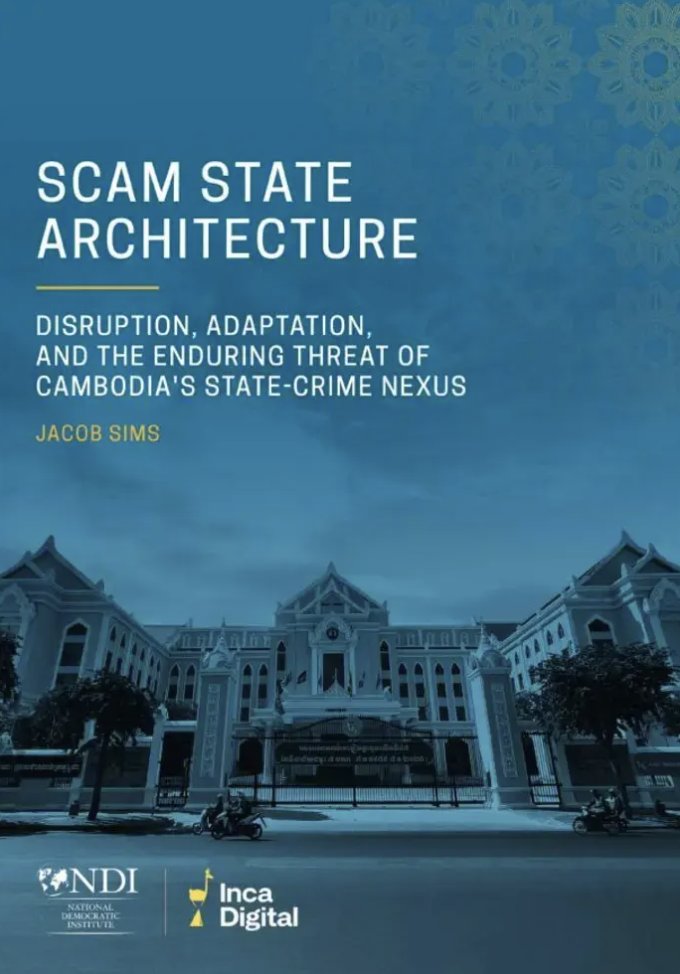
Many of Cambodia's notorious scam compounds may sit empty, but the criminal-political networks that built them remain undisturbed. A new report, “Scam State Architecture: Disruption, Adaptation, and the Enduring Threat of Cambodia’s State-Crime Nexus,” by Jacob Sims and published by the National Democratic Institute, warns that the Cambodian government's high-profile crackdown targets only the visible surface of the scam industry and shields Cambodia’s elite political actors who enable the scam economy from accountability.
What is scam state architecture?
Scam state architecture is “a durable arrangement of actors and protective functions that insulates political and economic elites from accountability while allowing criminal activity to operate and adapt at an industrial scale.” To construct this architecture, Cambodian elites welcome foreign criminal capital and provide the territory for growth. They then protect the industry through “elite mediators” who cloak it in the appearance of state legitimacy.
At its peak, Cambodia’s scam industry may have generated more than $37 billion in annual revenue and 40 percent or more of the primary host country’s gross domestic product. UN estimates calculate about 100,000 to 150,000 victims trapped in Cambodia’s scam industry, but this number is likely much higher given that Cambodia reported that 300,000 people fled the scam industry this year alone. At great personal risk, local activists and journalists have documented tens of thousands of trafficked individuals coerced into carrying out online fraud and held in guarded compounds linked to the country’s elites. If not for the work of Cambodian civil society groups and independent media, the international community would not have grasped the scale of this current crisis.
These stories began drawing global attention in 2021. The United States and the United Kingdom sanctioned companies and individuals tied to the industry, including the Prince Holding Group. Thailand physically targeted scam compounds during border strikes in December 2025. After China took custody of Prince Holding Group founder Chen Zhi in January 2026, Cambodia launched a highly publicized crackdown on the scam industry that included raids, announcements of arrests, and a mass exodus of workers fleeing the compounds. To the world, this crackdown looked like decisive government action, but “scam state architecture” is still intact.
Case studies throughout the newly released report from the National Democratic Institute demonstrate how this architecture works. One striking case is Ly Yong Phat, a longtime ruling-party senator and chair of its finance committee. Ly also holds Lok Neak Oknha, the highest title in Cambodia’s oknha system, which the monarchy grants to wealthy donors. The report calls Ly a “territorial oligarch.” Rather than directly managing scam operations, he supplies the required land, protection, and commercial cover. Casino complexes, special economic zones, and private compounds are often utilized as scam centers as they are privately secured, lightly regulated, and closely tied to local political authorities. All four compounds tied to Ly show signs of partial depopulation since the government crackdown, but the report notes that these efforts do not equate to elite accountability. Following U.S. sanctions on Ly, the Cambodian government rejected the accusations that Ly was involved in forced labor and trafficking and affirmed Ly’s role as a “legitimate contributor to national development.”
Recent crackdowns may push the illegal industry to adapt. It could re-emerge within Cambodia in a less visible or more politically insulated form, or it could move to a jurisdiction with lower levels of scrutiny. For example, there have been reports of new smaller scam operations in east and west Africa.
Even Cambodia’s established anti-trafficking institutions can enforce the industry’s legitimacy by promoting an industry-friendly narrative. Chou Bun Eng, one of the Cambodian government’s most prominent anti-trafficking representatives, repeatedly minimized the scam industry crisis in public statements. The report calls this a “central driver” of party-state disinformation. Similarly, law enforcement often limits investigations and deflects scrutiny from the political elite.
Key Recommendations
Dismantling the scam economy requires addressing the conditions enabling it. The report draws a comparison to counternarcotics. Though the drug trade has not been eliminated, states protecting drug trafficking will now face serious diplomatic, financial, and legal costs. This report calls for a similar norm for scam economies and proposes six recommendations:
- Protect the independent evidence pipeline by funding and defending local media and civil society;
- Target the elite mediators and political protection by directing sanctions and scrutiny at officials who protect the crime networks;
- Increase financial friction to prevent a scam economy from rebuilding;
- Deny “Reform Theater” by cooperating with the government in a way that does not avoid scrutiny of politically protected actors;
- Prevent industry adaptation by sustaining pressure to ensure compliance;
- Build a harm-minimization coalition between Cambodian civil society and international actors with a stake in dismantling the scam industry.
Up until now, accountability has been aimed at the wrong targets. Reforms should make the scam state architecture “harder to finance, harder to protect, harder to legitimize, harder to conceal, and harder to rebuild.”

Olivia Orr is a second-year law student at Vanderbilt Law School and a Raymonde Paul Scholar for International Law with a focus on international human rights.
Read Full Bio